How to Fit More Luggage in Your SUV for a Family Road Trip
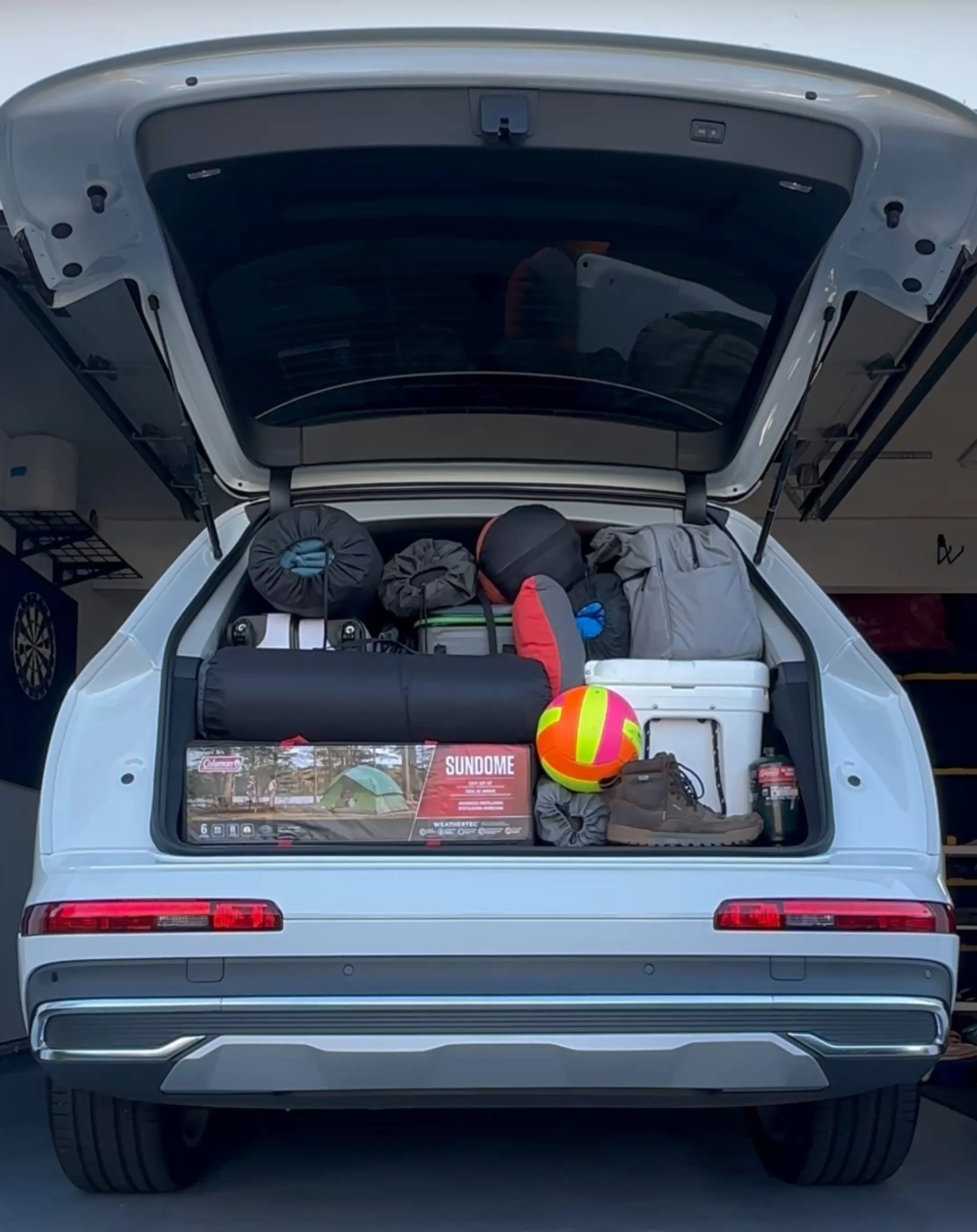
Running out of cargo space doesn't always mean you need a bigger vehicle. Here are the best ways to create more room for luggage, strollers, camping gear, and other road trip essentials.
Family road trips have a way of making even large SUVs feel small.
Once you add suitcases, a stroller, coolers, camping gear, sports equipment, and everything else your family needs for the trip, the cargo area can fill surprisingly quickly. If you're using the third row for passengers, you may have even less storage space than expected.
The good news is that you don't necessarily need to buy a larger vehicle or rent a full-size SUV just for one trip.
If your vehicle already fits everyone comfortably and luggage is the problem, adding temporary cargo space may be simpler than changing vehicles.
There are several ways to create more room in and around the SUV you already drive.
1. Add a roof cargo box
A roof cargo box creates additional enclosed storage on top of your vehicle.
Cargo boxes are especially useful for bulky but relatively lightweight items such as:
Suitcases and duffel bags
Strollers
Sleeping bags
Camping gear
Ski and snowboard equipment
Sports equipment
Beach gear
Children's travel items
Moving these items to the roof can free up the cargo area behind your seats and make it easier to keep the passenger cabin comfortable.
For families using a third row, a roof cargo box can be particularly useful because raising the third-row seats often reduces the amount of available luggage space.
You don't necessarily need to buy a cargo box
If you only take a few major road trips each year, renting a cargo box may make more sense than purchasing one.
Premium cargo boxes can cost $1,000 or more and require a large amount of garage storage when they're not being used.
A cargo box rental gives you temporary additional storage for the trip without having to purchase and store the equipment year-round.
For travelers in Southern California, Roof Rax rents premium Thule cargo boxes with delivery, professional installation, and pickup available throughout Orange County and surrounding areas.
2. Use a hitch-mounted cargo carrier
If your SUV has a trailer hitch, a hitch-mounted cargo carrier can add storage behind the vehicle.
These carriers are useful for coolers, bins, camping equipment, and other items that may be difficult to lift onto the roof.
One advantage of a hitch carrier is accessibility. Because the cargo sits lower than a roof-mounted box, loading and unloading can be easier.
However, hitch carriers may increase the overall length of your vehicle and can affect access to the rear hatch. Depending on the carrier, your luggage may also be more exposed to weather and road debris.
3. Replace hard suitcases with soft-sided luggage
Hard-shell suitcases are convenient for air travel, but their fixed shape can make them inefficient inside an SUV.
Soft-sided duffel bags can often be compressed into smaller spaces and arranged around other items.
For a road trip, consider using duffel bags for clothing and reserving rigid containers for items that actually need protection.
This can make it much easier to use irregular spaces throughout your cargo area.
4. Use vacuum storage bags for clothing and bedding
Bulky jackets, blankets, pillows, and other soft items can consume a surprising amount of cargo space.
Vacuum storage bags compress these items by removing excess air.
They can be especially helpful for:
Winter clothing
Ski jackets and pants
Sleeping bags
Blankets
Pillows
Keep in mind that you'll need a way to recompress the bags before the return trip if you plan to unpack them at your destination.
5. Pack vertically instead of creating one large pile
Many families load the trunk by placing bags on the cargo floor and stacking items wherever they fit.
A more efficient approach is to think vertically.
Use similarly sized bags or storage bins to create stable layers. Place heavier items at the bottom and lighter items above them.
Avoid creating a loose pile of luggage that shifts every time the rear hatch opens.
You should also avoid stacking unsecured items high enough that they could become dangerous during sudden braking.
6. Separate road trip essentials from destination luggage
One of the easiest ways to create a frustrating road trip is to bury something you need underneath all of your luggage.
Before loading the vehicle, separate your belongings into two categories.
Items needed while driving:
Snacks, chargers, medications, jackets, children's items, and anything you may need during a stop.
Items needed at your destination:
Suitcases, camping equipment, sports gear, and other items that can remain packed until you arrive.
Keep road trip essentials inside the passenger cabin or in an easily accessible area.
Destination luggage can be placed deeper in the cargo area or inside a roof cargo box.
7. Consider whether you actually need a larger rental vehicle
Renting a larger SUV or passenger van can solve a cargo-space problem, but it isn't always the most practical option.
Before changing vehicles, compare the cost and inconvenience of a rental with adding temporary storage to your existing SUV.
A larger rental vehicle may make sense if you need more passenger seats.
But if your current vehicle already fits everyone comfortably and luggage is the only problem, adding a roof cargo box or hitch carrier may be a simpler solution.
You can keep driving a vehicle you're familiar with while creating additional storage specifically for the trip.
You can combine more than one cargo-space solution
You don't have to choose only one of these options.
For many family road trips, the best approach is to combine several cargo-space strategies. For example, you might use vacuum storage bags to compress bulky jackets and bedding, pack clothing in soft-sided duffel bags, and move larger luggage or travel gear into a roof cargo box.
The goal is to use the available space more efficiently while moving items that don't need to be inside the passenger cabin to external storage.
A family using all three rows of an SUV, for example, may benefit from combining smarter packing techniques with temporary rooftop cargo space rather than switching to a larger vehicle.
What is the best way to add cargo space to an SUV?
The best option depends on what you're carrying and how often you need the additional storage.
A roof cargo box is often a strong option for families who want enclosed storage for luggage and travel gear.
A hitch cargo carrier can be useful for heavy items, coolers, and equipment that is difficult to lift overhead.
Soft luggage and compression bags can help if you only need to recover a smaller amount of interior space.
For many family road trips, these solutions can also be combined rather than used individually.
If your SUV fits your passengers comfortably but runs out of room once the luggage is loaded, adding temporary exterior cargo storage may be easier than switching to a larger vehicle.
Do you need crossbars for a roof cargo box?
Yes. A roof cargo box mounts to crossbars that run from side to side across the roof of your vehicle.
Some SUVs already have factory crossbars installed. Others only have roof rails and require compatible crossbars before a cargo box can be mounted.
If you're unsure, look at the roof of your vehicle.
Crossbars run side to side across the vehicle. Roof rails typically run front to back.
For many vehicles, compatible crossbars can be purchased or temporarily rented depending on the cargo box provider.
Roof Rax provides and professionally installs compatible rental crossbars for many vehicles, so customers do not necessarily need to purchase their own crossbars for a single trip.
Renting a cargo box for a Southern California road trip
If you're leaving from Orange County, Los Angeles, the Inland Empire, or the surrounding Southern California area, renting a cargo box can provide temporary additional storage without requiring you to purchase equipment you'll need to store after the trip.
Roof Rax provides premium Thule cargo box rentals for family road trips, camping trips, ski trips, and other travel throughout Southern California. Compatible rental crossbars are also available for many vehicles.
With delivery or self-pickup, professional installation, and removal after your trip, the service is designed to add temporary cargo space without requiring you to research, purchase, install, and store rooftop equipment yourself.