How to Fit More Luggage in Your Car for a Family Road Trip
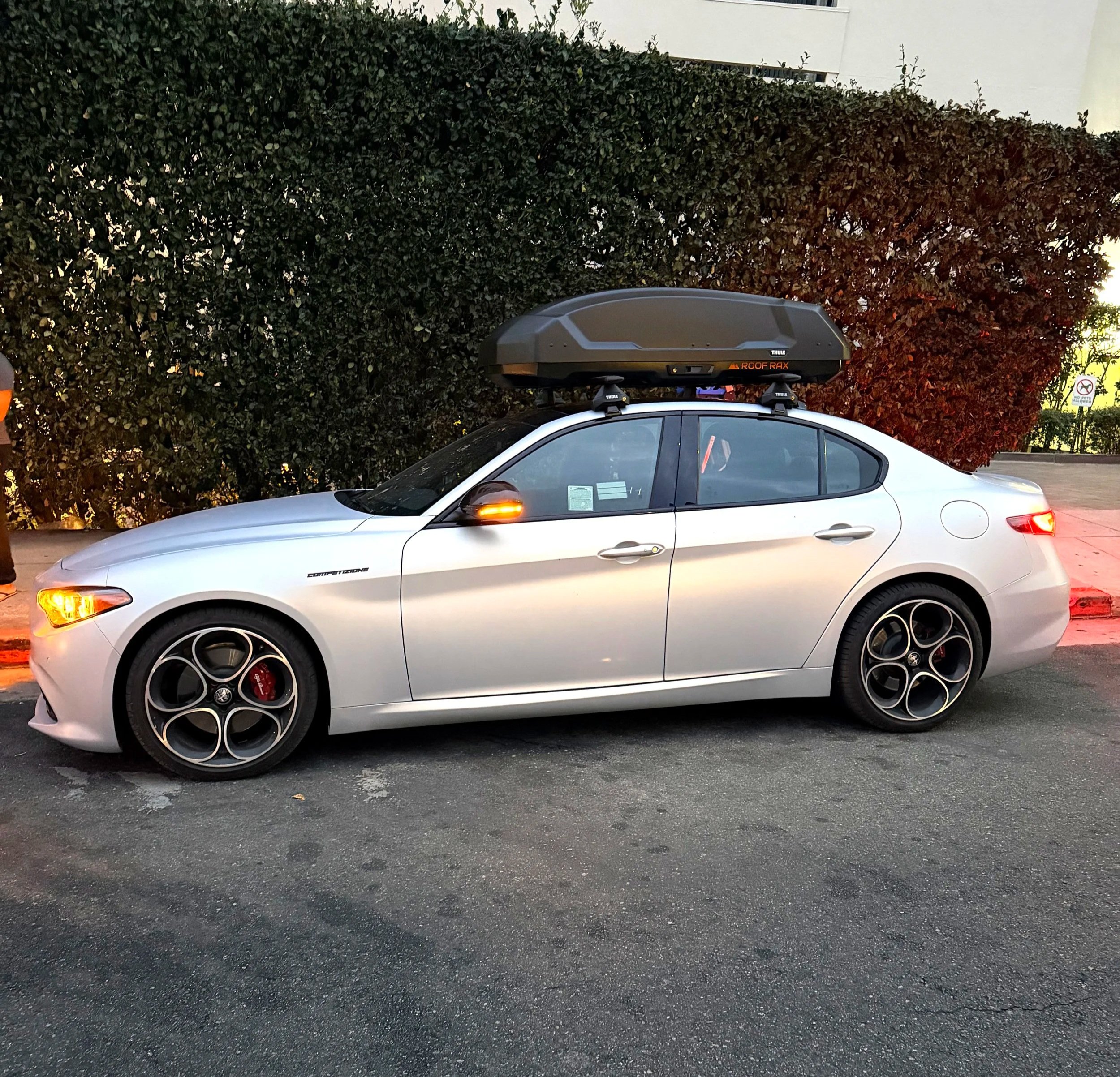
Alfa Romeo Giulia with Roof Rax Thule Force 3 M cargo box and crossbar rental
Running out of trunk space doesn't always mean you need a larger vehicle. Here are the best ways to create more room for luggage, coolers, camping gear, beach equipment, and other road trip essentials in your car, sedan, hatchback, or coupe.
Family road trips can make almost any car feel small.
After loading suitcases, coolers, children's gear, beach equipment, camping supplies, and everything else your family needs for the trip, it's easy to discover that your trunk fills up long before everything is packed.
Many families assume they need to rent an SUV for the trip.
But if your car already has enough seats for everyone traveling, the real problem may simply be cargo space—not passenger space.
Fortunately, there are several ways to create more room without buying a larger vehicle.
1. Add a roof cargo box
One of the easiest ways to add storage to a car is with a roof cargo box.
A roof cargo box creates secure, weather-resistant storage on top of your vehicle, allowing you to move bulky items out of the trunk while keeping the passenger cabin comfortable.
Cargo boxes work well for:
Suitcases and duffel bags
Beach gear
Camping equipment
Sleeping bags
Sports equipment
Children's travel items
Holiday luggage
Moving these larger items onto the roof frees up valuable trunk space for everyday essentials and can make long drives more comfortable for everyone inside the vehicle.
You don't necessarily need to buy a cargo box
If you only take a few road trips each year, purchasing a roof cargo box may not make financial sense.
Premium cargo boxes can cost $1,000 or more and require significant garage storage when they're not being used.
Renting a cargo box allows you to add temporary storage only when you need it.
Not sure whether renting or buying makes more sense? Read our guide comparing the pros and cons of renting vs. buying a roof cargo box.

Buying a cargo box?
If you plan to use a roof cargo box several times each year, purchasing one may make more sense than renting.
For most cars, we recommend the Thule Force 3 Medium. It offers an excellent balance of cargo capacity, vehicle compatibility, and ease of use, making it suitable for many sedans, hatchbacks, and smaller SUVs.
As an Amazon Associate, Roof Rax earns from qualifying purchases.
2. Replace hard suitcases with soft-sided luggage
Hard-shell suitcases are excellent for air travel, but they don't always make the best use of a car's trunk.
Soft-sided duffel bags can be squeezed into irregular spaces around other luggage, making it easier to maximize every inch of available storage.
If you're driving instead of flying, flexible luggage is often the better choice.
3. Use vacuum storage bags for bulky clothing
Jackets, blankets, pillows, and sleeping bags take up far more room than most people realize.
Vacuum storage bags compress these bulky items, allowing them to fit into much smaller spaces.
They're especially useful for:
Winter clothing
Blankets
Pillows
Sleeping bags
Bulky sweaters
If you'll unpack these items during your trip, remember you'll need a way to compress them again before driving home.
4. Pack the trunk strategically
Throwing luggage into the trunk one bag at a time often wastes valuable space.
Instead:
Place heavier items at the bottom.
Stack similarly sized bags together.
Fill small gaps with backpacks or soft bags.
Keep the load balanced from side to side.
A carefully packed trunk often holds considerably more than one that's loaded randomly.
5. Keep road trip essentials separate
One of the easiest mistakes is burying items you'll need throughout the drive underneath all of your luggage.
Before loading the car, separate your belongings into two groups.
Items you'll need during the drive:
Snacks
Chargers
Medications
Jackets
Entertainment for children
Water bottles
Items you'll only need at your destination:
Clothing
Camping equipment
Beach gear
Sports equipment
Keeping frequently used items within reach makes the trip much less stressful.
6. Use the passenger cabin wisely
If every seat isn't occupied, the rear seat can become valuable cargo space.
A cooler, duffel bags, or other lightweight items can often ride safely in unused seating positions.
If every seat is occupied, avoid stacking luggage high enough to reduce visibility or create a safety hazard during sudden stops.
7. Consider whether you actually need a larger rental vehicle
Many families assume renting an SUV or van are the only solutions once their trunk is full.
But ask yourself one question:
Do you need more passenger space, or do you simply need more room for luggage?
If everyone already fits comfortably in your current car, adding temporary cargo space may be more practical than changing vehicles.
A roof cargo box can often provide the extra storage needed while allowing you to continue driving a vehicle you're already comfortable with.
If you truly need additional passenger seating, then renting a larger SUV or passenger van may be the better option.
You can combine more than one cargo-space solution
You don't have to rely on just one solution.
Many families combine:
Soft-sided luggage
Vacuum storage bags
Better trunk organization
A roof cargo box
Using several techniques together often creates significantly more usable space than any one solution alone.
What is the best way to add cargo space to a car?
The best solution depends on how much additional storage you need.
Soft luggage and better packing may be enough for shorter trips.
For longer family vacations with multiple suitcases, camping equipment, beach gear, or sports equipment, a roof cargo box often provides the greatest increase in storage while keeping your passenger cabin uncluttered.
If your car comfortably seats everyone but the trunk fills up before everything is packed, adding temporary rooftop storage may be easier than renting a larger vehicle.
Do you need crossbars for a roof cargo box?
Yes.
A roof cargo box mounts to crossbars that run side to side across the roof of your vehicle.
Most cars do not come with crossbars already installed. In fact, many sedans have a bare roof with no roof rails at all.
The good news is that a bare roof doesn't necessarily mean you can't use a roof cargo box. Many vehicles have vehicle-specific roof rack systems that clamp securely to the door frame or attach to designated mounting points, allowing crossbars to be installed without permanent modifications.
Other cars may have factory roof rails that require compatible crossbars before a cargo box can be mounted.
If you're unsure what your vehicle needs, a cargo box provider can help determine whether your vehicle is compatible and which crossbar system is required.
Roof Rax provides compatible rental crossbars for most vehicles, allowing customers to rent both the crossbars and cargo box for a single trip instead of purchasing rooftop equipment they'll only use occasionally.
Renting a cargo box for a Southern California road trip
If you're traveling from Orange County, Los Angeles, the Inland Empire, or the surrounding Southern California area, renting a cargo box can provide temporary additional storage without requiring you to purchase equipment you'll only use occasionally.
Roof Rax provides premium Thule cargo box rentals for family vacations, camping trips, ski trips, beach trips, and other travel throughout Southern California. Compatible rental crossbars are also available for many vehicles.
With delivery or self-pickup, professional installation, and removal after your trip, the service is designed to add temporary cargo space without requiring you to research, purchase, install, and store rooftop equipment yourself.